
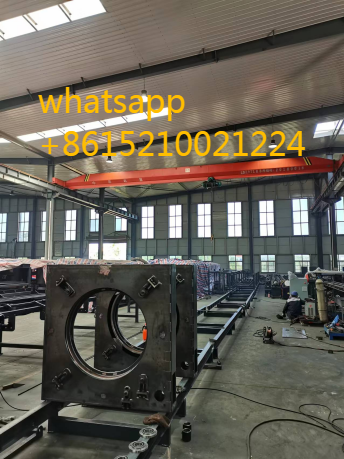
How Pile Cage Welding Machine work and rebar cage making machine workflow
How Pile Cage Welding Machine work and rebar cage making machine workflow
A pile cage welding machine, also known as a rebar cage making machine, is a specialized piece of equipment used to automate the fabrication of steel reinforcement cages for deep foundations like piles. These cages are critical for providing tensile strength and structural integrity to concrete piles in major construction projects such as bridges and high-rise buildings. While methods like site-fixing with tying wire and manual welding are still used, modern machines offer superior speed, precision, and consistency. The operation of a typical CNC or semi-automatic pile cage machine is a multi-stage process that can be broken down into several key steps
itech Best selling CNC high quality automatic stirrup bending machine / CNC stirrup bender machine widely use in reinforcement steel wire bar cut and bend factory. Itech as professional reinforcing steel machine supplier. Itech have a series of steel rebar bender machine,like CNC 16mm Stirrup Bending machine,CNC 20mm stirrup bar bending machine , 14mm stirrup wire bending machine and bar shape machine ,automatic rebar pile cage welding machine,cnc automatic pile cage making machine , automatic truss lattice girder welding machine and many kinds of rebar machine. To solve the gap on the stirrups ,Itech stirrup bending machine adopt advanced anti twist feeding system to avoid twist of steel, make stirrup more quick and standard.Shape and bend stirrups effortlessly with our cutting-edge bending machine.
The Step-by-Step Working Process of a Pile Cage Machine
A pile cage machine is a specialized piece of equipment used to automate the production of steel reinforcement cages for deep foundation piles. This process transforms raw steel bars into a strong, cylindrical framework that provides structural integrity to concrete piles. The operation involves a precise, multi-stage workflow that combines mechanical rotation, feeding, and welding.
- Machine Setup and Parameter Input
The process begins with the machine setup. An operator configures the machine based on the specific project’s engineering requirements. This includes defining key parameters such as the cage diameter, length, spiral pitch (the distance between each coil of the spiral wire), and the number of longitudinal bars. These specifications are entered into the machine’s PLC (Programmable Logic Controller) control system, which will guide the entire automated production run.
- Loading Longitudinal Bars
The main structural framework of the pile cage is created by **longitudinal bars**, which run the entire length of the cage. In this step, these straight steel bars are loaded into the machine. The machine features holding or gripping devices to secure the bars at both ends, ensuring they are positioned correctly and aligned to form a precise circular or polygonal pattern. This secure positioning is crucial for maintaining the cage’s geometry and preventing twisting during the process.
- Winding the Spiral Wire
Once the longitudinal bars are secured, the machine begins to form the cage’s outer structure. A continuous length of **spiral wire** (also known as a stirrup) is fed into the machine from a decoiling unit. The machine’s rotating head or carriage then begins to wind this wire around the stationary, or slowly moving, longitudinal bars. This creates a helical, or spiral, pattern that will eventually encase the longitudinal bars and hold them in place. The spacing between each loop of the spiral is precisely controlled to meet the required design specifications.
- Automated Welding and Cage Formation
As the spiral wire is wound onto the longitudinal bars, the welding process occurs simultaneously. This is the most critical step where the cage’s structural integrity is determined. The machine uses an automated welding system, typically a welding electrode that rotates around the cage, to join the spiral wire to every point where it crosses a longitudinal bar. Some advanced systems even feature welding robots that adjust their position to ensure consistent, high-quality welds even on complex cage shapes like squares or rectangles. This precise and repeatable welding is a key advantage over manual fabrication methods.
- Output and Cage Delivery
As the welding process concludes at one end of the cage, the completed section is progressively moved out of the machine. The support heads and gripping devices guide the newly formed cage onto an unloading system, such as a loading module, which prepares it for removal. This continuous production cycle allows for the efficient manufacturing of cages in varying lengths, limited only by the machine’s design and the available workspace.
Itech is professional steel wire/bar processing machinery China supplier,stirrup bending machine price , steel rebar bending machine,foundation pile cage making machine,,steel wire straightener,wire straightening and cutting machine, wire mesh welding machine,rebar shear line,rebar sawing&threading line and related cnc plasma cutting machine, laser cutting machine can meet different customers’ requirement.
 16mm stirrup bender
  stirrup bending machine
 straightening and cutting machine
 wire mesh welding machine
 wire mesh welding machine itech
 cage making machine


 mother's day
  canton fair


Leave a Reply
Want to join the discussion?Feel free to contribute!